
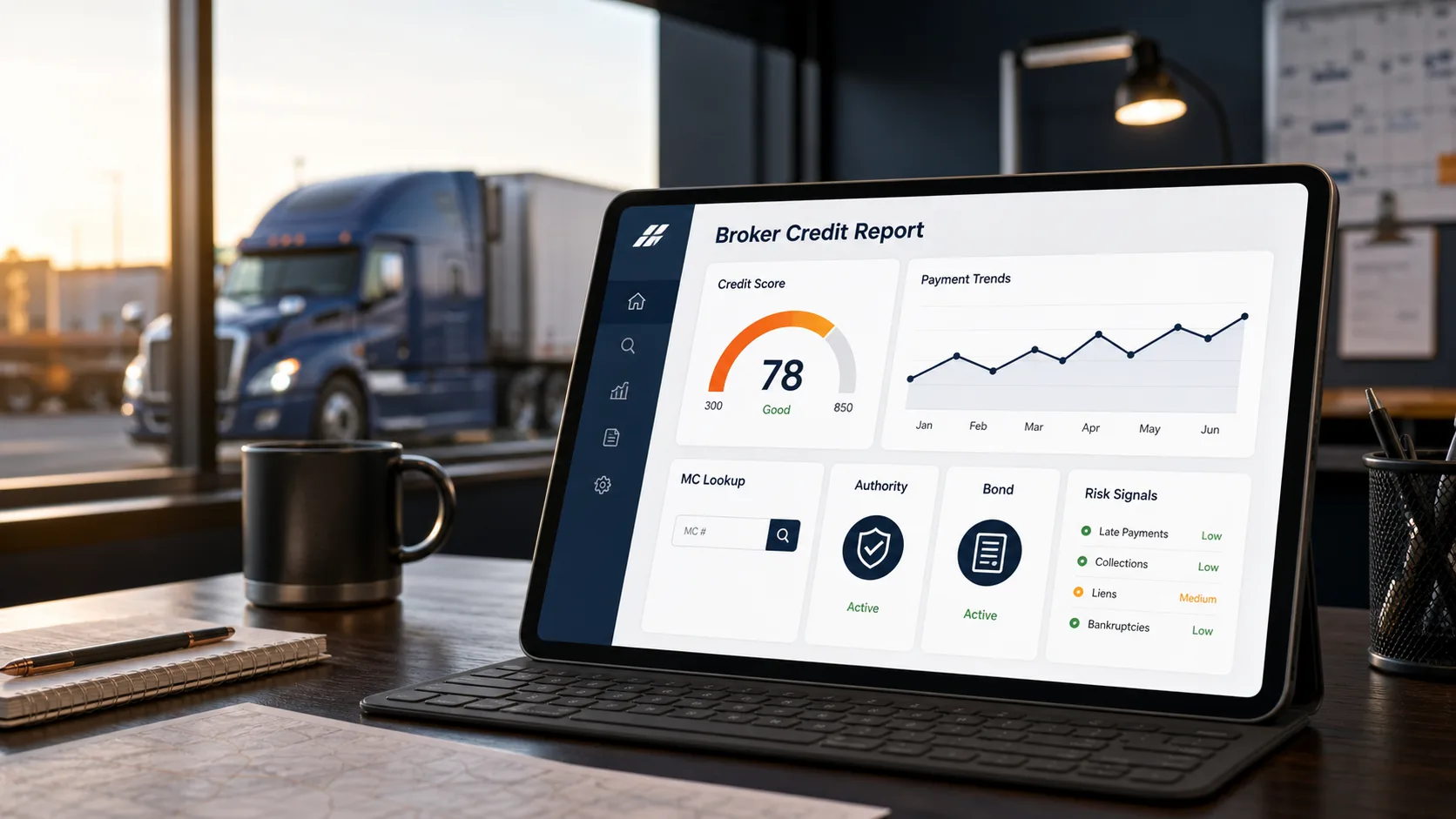
Before a carrier accepts a load, the rate is usually the first thing everyone looks at. The lane, pickup time, delivery window, equipment type, and miles all matter too.
But there is another question that can matter just as much: Who is responsible for paying the invoice?
A freight broker credit report helps carriers, owner-operators, dispatchers, and small fleets review payment-risk information before agreeing to haul freight for a broker. It is not a guarantee that a broker will pay. It is not legal advice. It is not the same thing as a bank credit decision. But it can give carriers useful context before they commit fuel, time, equipment, and cash flow to a load.
For trucking businesses operating on tight margins, that context matters.
What Is a Freight Broker Credit Report?
A freight broker credit report is a business-risk profile that helps carriers review information about a freight broker before accepting a load.
Depending on the service or data source, a broker credit report may include:
- Broker company name and identifying information
- MC number or DOT-related registration details
- Authority status
- Bond or trust information
- Business address and contact information
- Payment trends or estimated days to pay
- Past-due invoice reports or payment concerns
- Business history or public-record context
- Risk indicators that may deserve a closer look
The purpose is simple: help carriers make a more informed decision before booking freight.
A broker credit report does not tell the entire story. Some newer brokers may have limited history. Some established brokers may have changing payment behavior. A good report should be treated as one part of the decision, not the only factor.
Why Freight Broker Credit Reports Matter for Carriers
A load can look profitable on the load board and still create cash-flow problems later.
Owner-operators and small carriers often pay expenses before they get paid. Fuel, insurance, truck payments, maintenance, driver pay, factoring fees, tolls, and other costs do not wait just because a broker invoice is delayed.
If a broker pays slowly, disputes paperwork, becomes unresponsive, or has other payment issues, the carrier may be left carrying the financial burden.
That is why many carriers want to check broker credit before they haul.
A freight broker credit report can help answer practical questions like:
- Does this broker appear to have active authority?
- Is there bond or trust information on file?
- Are there payment-risk signals I should review?
- Are there past-due invoice concerns?
- Does the broker's business information match the paperwork?
- Does this broker appear risky enough to avoid, factor, or request different terms?
The goal is not to eliminate every risk. The goal is to avoid accepting loads blindly.
Freight Broker Credit Report vs. MC Number Lookup
A freight broker credit report and an MC number lookup are related, but they are not the same thing.
An MC number lookup usually helps identify a broker and review public registration information. That can include authority status, legal name, address, and other publicly available details.
A freight broker credit report goes a step further by adding payment-risk context. That may include payment trends, credit limit suggestions, days-to-pay signals, or reported invoice concerns.
In plain English: MC number lookup tells you who the broker is. A broker credit report helps you evaluate payment risk.
Carriers should consider both before accepting freight from a broker they do not know well.
What Should Carriers Check Before Accepting a Load?
Before accepting a load, carriers should review more than the posted rate.
A basic broker check may include:
- Confirm the broker's legal name and MC number.
- Review authority status.
- Check bond or trust information.
- Compare contact details against the rate confirmation.
- Look for payment-risk indicators.
- Review days-to-pay or payment trend information where available.
- Watch for double-brokering or impersonation warning signs.
- Consider whether the load terms match the risk.
No single item proves a broker is safe or unsafe. But several warning signs together may be enough to slow down, ask more questions, request different terms, or decline the load.
What Are Common Broker Payment-Risk Signals?
Broker payment-risk signals can vary by platform, but carriers should pay attention to patterns that may affect cash flow.
Common signals include:
- Slow payment history
- High average days to pay
- Past-due invoice reports
- Inconsistent business details
- Recent authority or bond concerns
- Limited available history
- Reports of double brokering or identity concerns
- Unclear communication about paperwork or payment terms
Some of these signs may have reasonable explanations. Others may indicate a higher-risk broker relationship.
The important thing is that carriers should review the information before the truck is already loaded.
Is a Freight Broker Credit Report a Guarantee?
No. A freight broker credit report is not a guarantee that a broker will pay.
Even a broker with a strong payment history can have future problems. And a broker with limited information is not automatically bad. Credit reports and risk tools are decision-support resources. They help carriers review available information and make a better-informed business decision.
Carriers should still use their own judgment, paperwork review, factoring relationships, insurance guidance, and legal or collection resources where appropriate.
Who Uses Freight Broker Credit Reports?
Freight broker credit reports are useful for:
- Owner-operators
- Small trucking companies
- Dispatchers
- Fleet owners
- Carrier operations teams
- Factoring companies
- Back-office staff reviewing new broker relationships
For a large carrier, broker review may be part of a formal credit department. For an owner-operator, it may be a fast check before accepting a load from a load board.
Either way, the question is the same: Do I know enough about this broker before I haul the freight?
How SureLoadr Helps
SureLoadr is being built to help owner-operators and carriers review broker payment-risk intelligence from a mobile-first workflow.
The goal is to make broker review faster and easier before the load is booked.
SureLoadr helps carriers review information such as broker identity, public registration context, authority and bond details, payment-risk signals, and past-due invoice reporting where available — the same ground a full freight broker credit check covers.
SureLoadr is not a lender, bank, credit bureau, legal advisor, collection agency, or guarantee of broker behavior. It is a decision-support tool designed to help carriers check before they haul.
Final Thought
A freight broker credit report is not about overcomplicating the load-booking process. It is about adding one more practical check before committing your truck, fuel, time, and business reputation.
Before you book the load, know who you are hauling for.
SureLoadr helps carriers check before they haul.
Frequently asked questions
What is a freight broker credit report?
A freight broker credit report is a business-risk profile that helps carriers review broker identity, authority, bond information, payment trends, and payment-risk signals before accepting a load.
In what order should a carrier verify a broker?
Work from identity outward. Confirm the legal name and MC number first, then authority status and bond information, then the contact details, and only then the payment-risk history. Order matters because credit context is only meaningful once you know it describes the company actually offering you the load. If anything in that sequence does not match the paperwork, stop and verify before dispatch rather than after.
What does a broker credit report add that an MC number lookup does not?
Payment-risk context. An MC number lookup identifies the broker and shows public registration details such as authority status, legal name, and address. A credit report layers on how the broker appears to pay: payment trends, estimated days to pay, credit limit context, and reported past-due invoice concerns. In plain English, the lookup tells you who the broker is, and the credit report helps you judge whether hauling for them is worth the wait.
Can a freight broker credit report tell me if a broker will pay?
No report can guarantee payment. A freight broker credit report provides decision-support information so carriers can better evaluate risk before accepting a load.
Why should owner-operators check broker credit?
Owner-operators often carry the upfront cost of a load. Checking broker credit and payment-risk signals can help protect cash flow and avoid preventable payment problems.
Who uses freight broker credit reports besides carriers?
Dispatchers, fleet owners, carrier operations and back-office staff, and factoring companies all use them. The workflow differs by size. A large carrier may run broker review through a formal credit department with set limits and approval steps. An owner-operator may run the same check in a couple of minutes on a phone before accepting a load off a board. The underlying question is identical: do I know enough about this broker before I haul the freight?