
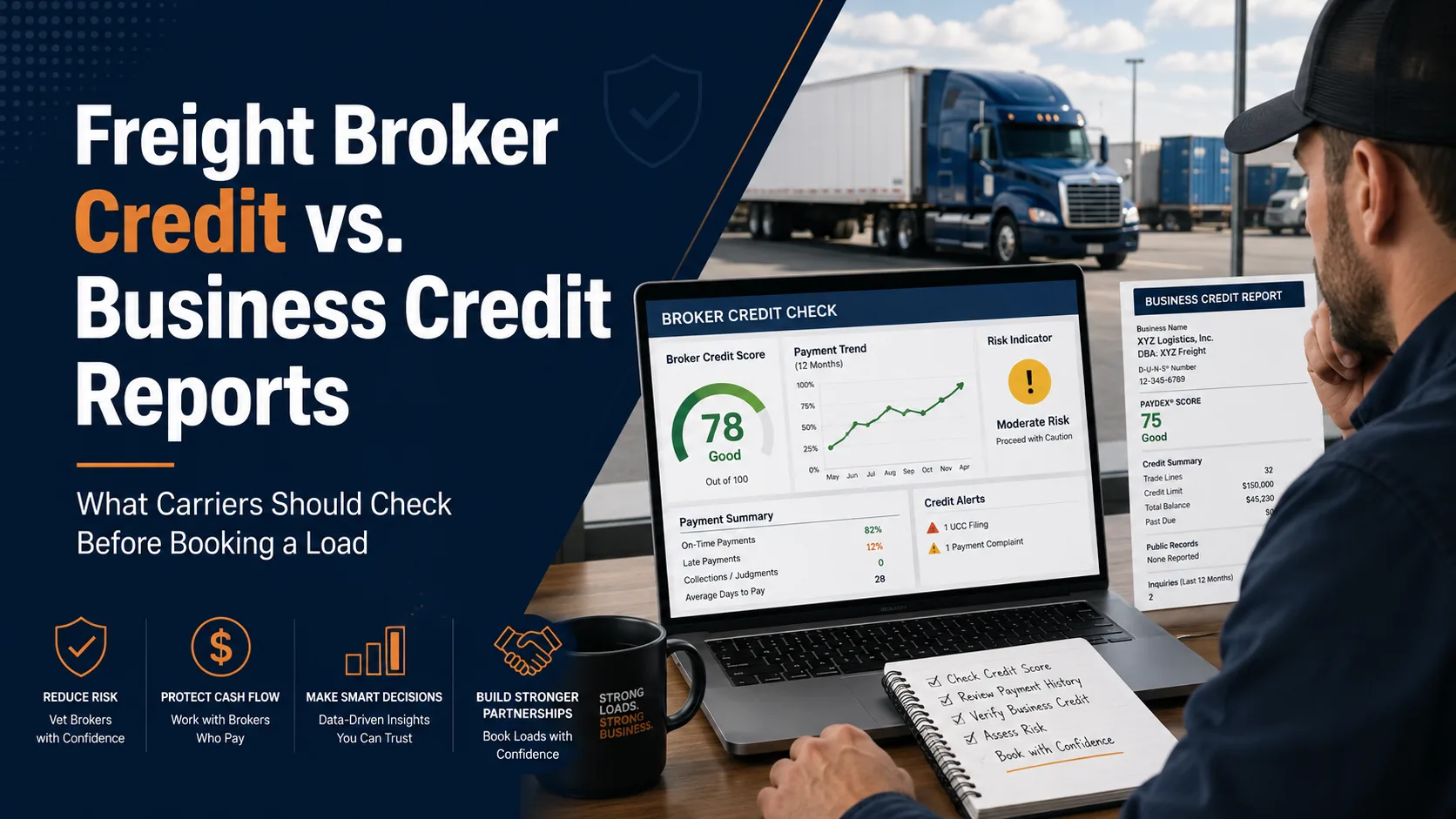
A freight broker may look like a solid business on paper and still create payment problems for a carrier. That is why knowing the difference between freight broker credit and a general business credit report matters before accepting a load.
Both reports can provide useful information, but they are built to answer different questions. A traditional business credit report looks at a company's broader commercial credit profile. A freight broker credit check is more focused on the questions carriers care about: who is offering the load, how the broker appears to pay freight bills, and whether the available risk signals support accepting more exposure.
For owner-operators and small fleets, that distinction can affect cash flow, factoring decisions, collections work, and whether a good-looking rate becomes a profitable load or an unpaid invoice.
Freight Broker Credit vs. Business Credit: The Short Answer
For a pre-load decision, lead with the freight broker credit report and use business credit as background. The freight-specific report is built around the question a carrier is actually asking, which is whether this broker pays freight invoices and how long it takes, so it carries days-to-pay, payment trends, broker authority and bond status, and reported past-due activity. A general business credit report answers a lender's or supplier's question instead, and a broker can look established there while still paying carriers slowly.
What Freight Broker Credit Measures
Freight broker credit is payment-risk information organized for the carrier-broker relationship. It helps a carrier evaluate whether a broker appears likely to handle freight invoices reliably and whether there are warning signs worth reviewing before the truck is committed.
A useful freight broker credit report may combine a broker credit score with payment trends, estimated days to pay, credit limit context, identity information, authority and bond details, public-record signals, and reported past-due invoice activity. The goal is not to label a broker as good or bad based on one number. The goal is to help the carrier understand the available risk picture.
A freight broker credit check is especially useful when a carrier is considering a new broker, increasing its unpaid exposure with an existing broker, or deciding whether a load's rate is worth the payment risk.
What a Business Credit Report Measures
A business credit report is a broader commercial profile used by lenders, suppliers, vendors, insurers, and other companies evaluating whether to extend credit or enter a business relationship. Depending on the source, it may include a business credit score, trade accounts, balances, payment experiences, credit limits, public filings, collections, judgments, liens, or other company information.
That information can help answer whether a company appears financially established and how it has handled certain commercial obligations. However, a general business credit report may not be organized around freight invoices, carrier payment timing, broker authority, bond information, or the specific exposure created when a truck accepts a load.
In other words, a business credit report can be useful background, but it may not tell a carrier everything needed for a pre-load decision.
Freight Broker Credit vs. Business Credit Reports: The Main Difference
The main difference is perspective. A business credit report evaluates the company as a commercial credit subject. A freight broker credit report evaluates the broker through the practical risk concerns of carriers that haul freight and wait to be paid.
| What you are checking | Freight broker credit report | Business credit report |
|---|---|---|
| Core question | Will this broker pay this freight invoice, and how fast? | Is this company an established commercial credit subject? |
| Payment trends | Freight-invoice payment behavior, and whether it is improving or weakening | Broad trade-line payment experiences across vendors and suppliers |
| Days to pay | Estimated average days to pay on freight invoices | Rarely broken out for freight specifically |
| Authority and bond data | Broker MC authority status, plus bond or trust information where available | Not typically included |
| Past-due and complaint signals | Carrier-reported past-due invoices and collection-related warning signs | Public collections, judgments, and liens |
| Exposure guidance | Credit limit context sized to how much freight you can carry unpaid | Credit limits framed for trade or lending decisions |
| Workflow fit | Meant to be checked in the minutes before a load is covered, including from a phone | Usually pulled once, during onboarding or a credit setup |
| Built for | Carriers, owner-operators, small fleets, and factoring companies | Lenders, suppliers, insurers, and vendors |
| Best fit | The go/no-go call before equipment is committed | Background on whether the company is financially established |
Neither type of report guarantees payment. The value comes from using the right information for the decision being made.
Why a General Business Credit Report May Not Be Enough for a Carrier
A carrier is not making the same decision as a bank or office-supply vendor. When a carrier accepts a load, it commits equipment, fuel, insurance, driver time, maintenance capacity, and operating cash before payment arrives. The carrier may then wait 30, 45, 60, or more days for the invoice to be paid.
That makes payment timing important. A business can be active and established while still paying freight invoices more slowly than a small carrier can comfortably handle. A general business credit report may not clearly show the days-to-pay information, freight-payment patterns, factoring concerns, or recent broker-specific warning signs that matter most on the road.
Carriers also need to confirm that the company on the report is the same company offering the load. Similar names, changed contact details, mismatched MC numbers, or impersonation attempts can turn an otherwise useful credit report into information about the wrong business.
What a Freight Broker Credit Check Should Include
A practical freight broker credit check should help the carrier move from identity verification to payment-risk review. Before accepting freight, consider checking:
- The broker's legal name, DBA name, MC number, and business contact details.
- Whether broker authority appears active.
- Bond or trust information where available.
- A freight broker credit score and the risk range behind it.
- Estimated days to pay and whether the payment pattern is improving or weakening.
- Recommended credit limit or exposure context.
- Past-due invoice reports, payment complaints, or collection-related warning signs.
- Public-record information that may affect the risk decision.
- Whether the rate confirmation and contact information match the verified broker record.
A single strong signal should not erase several warning signs. In the same way, limited information does not automatically mean a broker is unsafe. It means the carrier may need to ask more questions, reduce exposure, use different payment terms, or decide that the load does not fit its risk tolerance.
Where a Business Credit Report Still Helps
A business credit report can still add valuable context. It may help confirm that the business has an established commercial file, show broader trade-payment experiences, identify public filings, or reveal credit events that deserve attention.
The mistake is not using business credit information. The mistake is treating broad business credit as a complete substitute for freight broker credit intelligence. The strongest review uses the available information together and keeps the carrier's real exposure at the center of the decision.
Choosing a Freight Broker Credit Report Service
Report type is the first decision. The provider is the second, and the features worth comparing are the same rows in the table above: a credit score with the risk range behind it, estimated days to pay, payment trends, authority and bond status, how often the data is refreshed, whether monitoring costs extra, and whether the check can be run from a phone at the dock instead of a desktop portal back at the office.
That last point decides more outcomes than it looks like it should. A report that takes ten minutes and a laptop to pull is a report that gets skipped on the loads booked in a hurry, and those are exactly the loads worth checking.
For a feature-by-feature look at specific services, see our comparison of the best freight broker credit check tools. If you run one to ten trucks, choosing a broker credit report as an owner-operator covers what changes at that size, and freight broker credit in load planning covers fitting the check into an existing dispatch routine.
How Carriers Can Use Both Reports Before Booking a Load
A repeatable process helps carriers avoid making credit decisions based only on the posted rate or the pressure to book quickly. A practical workflow can look like this:
- Verify the broker's identity and MC number before reviewing credit information.
- Review freight broker credit, payment trends, and days-to-pay signals.
- Use a business credit report for broader commercial background when available.
- Compare authority, bond, public-record, and contact details.
- Calculate how much unpaid exposure you already have with that broker.
- Decide whether the rate, payment timing, and risk level fit your business.
- Save the records and paperwork used for the decision.
This process does not need to take hours. The objective is to make a consistent check before accepting the load, when the carrier still has the ability to ask questions or walk away.
A Simple Example of Why the Difference Matters
Imagine a broker with an established business file and an acceptable general business credit score. At first glance, that may look reassuring. But a freight broker credit report shows that average payment time has recently increased, carrier invoices are aging longer, and the carrier already has several unpaid loads with the broker.
The general business credit report was not necessarily wrong. It answered a broader question. The freight broker credit check added the carrier-specific context needed for the next load decision. The carrier might still accept the load, but it can now consider a lower exposure limit, quicker payment terms, factoring availability, or a different broker.
Common Credit-Checking Mistakes Carriers Should Avoid
- Checking only whether the company exists and ignoring how it appears to pay.
- Treating active authority as proof of strong credit.
- Relying on one business credit score without reviewing the underlying signals.
- Ignoring recent payment trends because older history looked acceptable.
- Reviewing the right report for the wrong company because the MC number was not verified.
- Accepting repeated loads without tracking total unpaid exposure.
- Assuming a high rate makes slow payment or collection risk worthwhile.
How SureLoadr Supports a Freight Broker Credit Check
SureLoadr is built for carriers, owner-operators, and small fleets that need freight broker credit intelligence before accepting a load. The mobile workflow helps users review broker identity, credit report context, credit scores, payment trends, authority and bond details, past-due invoice signals, and other payment-risk indicators from the road.
The purpose is not to replace a carrier's judgment or promise that a broker will pay. It is to make relevant information easier to review before equipment, fuel, time, and cash flow are committed. Download the SureLoadr Mobile App to start a 7-day free trial, or read our freight broker credit guide first.
Bottom Line
Freight broker credit and business credit reports are related, but they are not interchangeable. A general business credit report can help a carrier understand the company. A freight broker credit check helps the carrier understand the risk of hauling for that broker and waiting to be paid.
Before booking a load, verify the broker, review freight-payment behavior, consider broader business credit context, and decide whether the rate is worth the exposure. Better information cannot remove every risk, but it can help carriers avoid making important credit decisions blindly.
SureLoadr is decision-support software. It is not a lender, bank, credit bureau, legal advisor, collection agency, or payment guarantee.
Frequently asked questions
Is freight broker credit the same as business credit?
No. Business credit describes a company's broader commercial credit profile. Freight broker credit focuses more directly on broker identity, freight-payment behavior, days-to-pay patterns, carrier exposure, and other information relevant to accepting a load.
What is on a freight broker credit report that a business credit report leaves out?
The freight-specific pieces: estimated average days to pay on freight invoices, payment trends showing whether that behavior is improving or weakening, broker authority status, bond or trust details, carrier-reported past-due invoices, and credit limit context sized to unpaid freight exposure. A business credit report may cover trade lines, balances, public filings, collections, judgments, and liens, but it is rarely organized around freight invoices or the moment a carrier commits a truck. Available data varies by broker and source.
Should carriers review a business credit report before hauling?
A business credit report can provide useful background, but carriers should also review freight-specific payment risk, broker identity, authority, bond information, paperwork consistency, and their total unpaid exposure.
Does a strong business credit score guarantee broker payment?
No. No credit score or report guarantees payment. Credit information is decision-support context and should be combined with verification, current payment signals, written terms, and the carrier's own business judgment.
Which report should an owner-operator check first?
The freight broker credit report. For a single truck or a small fleet, the decision turns on how quickly the broker pays freight invoices and how much you already have outstanding with them, and both of those live in the freight-specific report. Pull business credit as background when the broker is new to you or the exposure is larger than usual.
Do freight broker credit reports fit into a TMS or load planning workflow?
It depends on the provider. Some return broker credit data only through a web portal, which means stepping outside dispatch to check it. Others offer a mobile lookup or an API so the check happens inside load planning, before the load is covered. How the report reaches you matters as much as what is in it, because a check that is slow or awkward to run tends not to get run on the loads booked under time pressure.