
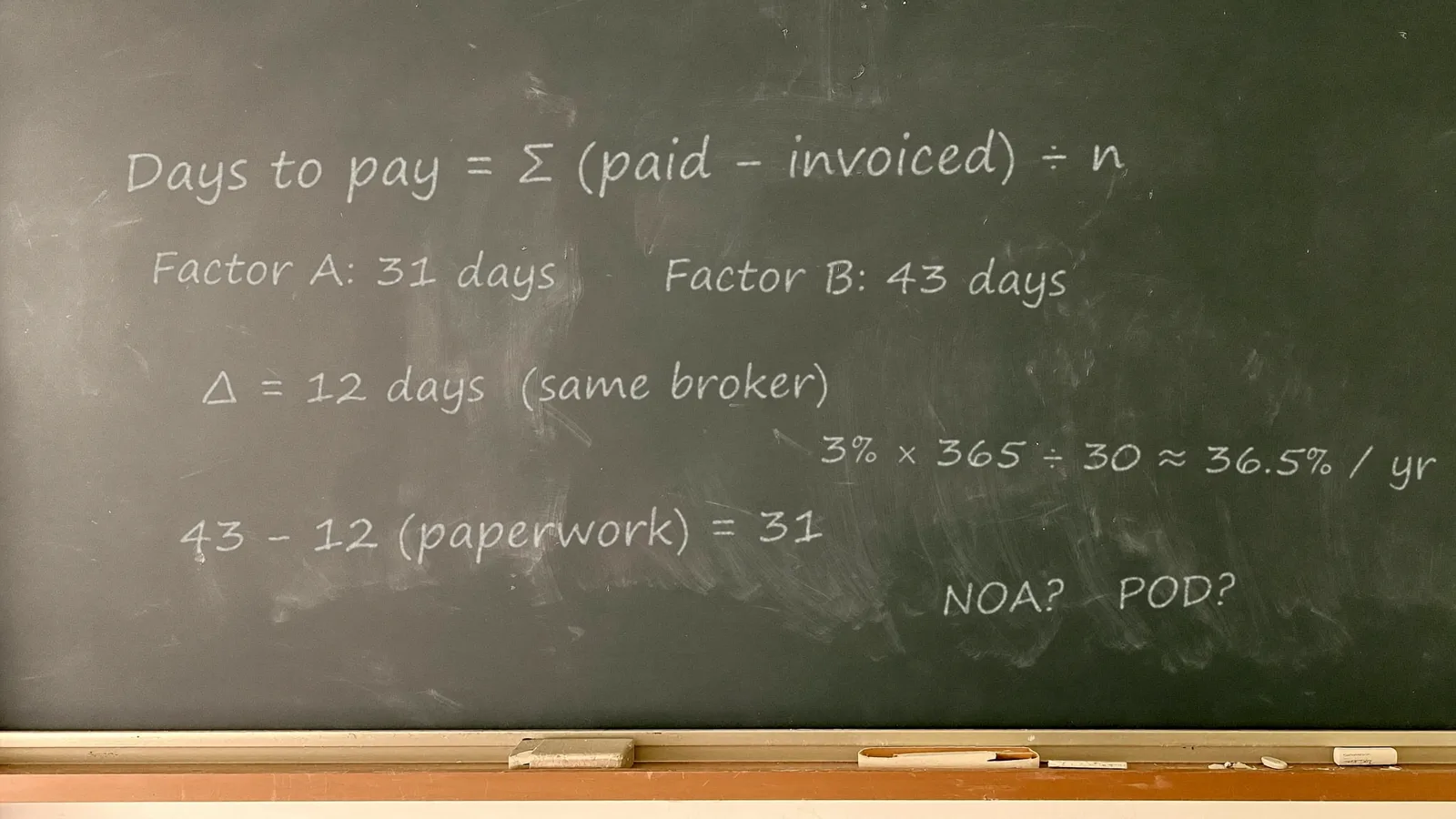
Factoring company payment reports are reliable for one thing and unreliable for another. They are real payment data, drawn from invoices a factoring company actually bought and actually collected, so they are good at telling you whether a broker pays and whether it pays faster or slower than other brokers. They are much weaker as a literal day count. The days-to-pay figure on a factoring report usually runs longer than the broker's true payment speed, because it includes delays caused by paperwork between the factoring company and the broker, not just the broker's own habits.
That difference matters when you are deciding whether to book a load. A broker showing 42 days on one report may be a 30-day payer that a particular factoring company has trouble collecting from. Read the number as a ranking, not a promise.
What a factoring payment report actually measures
When a carrier factors an invoice, the factoring company buys it, advances most of the money, and then collects from the broker. The days-to-pay figure on its report is how long the broker took to pay the factoring company across the invoices it collected. It is the factoring company's own collection experience, averaged.
That is genuinely useful information. Nobody sees more paid invoices for a broker than the companies that buy them. But it is one company's experience with its own clients' invoices, over its own window of time, measured from its own starting point. Every one of those choices moves the number.
Why factoring days-to-pay numbers run long
Anyone who has worked in freight credit has seen invoices sit unpaid for reasons that have nothing to do with the broker's money. The most common ones:
- The notice of assignment never reached the broker. Until a broker has the notice telling it to pay the factoring company instead of the carrier, it has no reason to send the money there.
- The broker paid the carrier directly. If no notice arrived, paying the carrier was the correct thing to do from the broker's side. The factoring company may still record that invoice as unpaid or very late.
- Proof of delivery or the rate confirmation was missing. Most brokers will not release payment on an invoice without a signed delivery receipt, and the clock keeps running while the paperwork is chased.
- Small disputes held the whole invoice. A disagreement over detention, a lumper receipt or a short-paid line can park an otherwise clean invoice for weeks.
- The clock started early. A report that counts from the day the factoring company bought the invoice, not the day the broker received a complete billing packet, adds days the broker never controlled.
None of this makes the reports wrong. It makes them long. The friction is roughly the same across every broker a factoring company collects from, so a broker that sits well behind the rest of that company's book really is slow. But the raw day count overstates how long a typical invoice takes when the paperwork is clean.
Factoring companies rarely agree on the same broker
SureLoadr compared the days-to-pay figures that different factoring companies currently report for the same brokers. For about three in ten brokers covered by more than one factoring company, the figures differ by 10 days or more. Same broker, a different answer depending on whose report you read.
The gap is not a sign that one of them is lying. Each factoring company has a different mix of clients, different lanes and different collection habits, and each one sees only its own slice of the broker's invoices. A broker that pays a large, organized factoring company promptly can look slow on a report built from a few small carriers who send incomplete packets. That is why a single report, from any one source, is a weak basis for a hard rule like "never book a broker over 45 days."
How to read a factoring payment report before you book
- Check how much data is behind the number. A figure built on thousands of invoices from dozens of carriers is a fact. A figure built on six invoices from two carriers is an anecdote. If the report shows invoice or carrier counts, read them first.
- Compare recent to all-time. A broker whose recent figure is much slower than its long-run average is changing, and the direction matters more than either number on its own.
- Rank the broker, do not just read the days. Ask whether it pays faster or slower than most brokers, not whether it hits an exact day count.
- Treat a no-buy or credit hold as the real warning. When a factoring company stops buying a broker's invoices, it is telling you something no day count can.
- Look for agreement. When more than one source shows a broker slowing down, believe it. When one report is an outlier, find out why before you act on it.
For the broader picture of what payment behavior to watch and which warning signs show up first, see our guide to freight broker payment trends.
Where SureLoadr fits
SureLoadr does not rely on one factoring company's view of a broker. Our proprietary algorithm combines multi-source payment data using advanced analytics, and that data is scanned, tracked and reviewed daily. The result is a single days-to-pay figure and payment trend on every broker report, alongside authority, bond, non-payment reports and a 1 to 100 credit score. A freight broker credit check on SureLoadr costs $10 a report, or unlimited from $49 a month, and broker credit monitoring emails you when a broker you haul for starts to slip.
Frequently asked questions
How reliable are factoring company payment reports?
Factoring company payment reports are reliable for telling whether a broker pays and whether it pays faster or slower than other brokers, but their days-to-pay figures usually run long. SureLoadr treats them as a ranking rather than a literal day count, because the number includes paperwork delays between the factoring company and the broker, such as a missing notice of assignment or proof of delivery.
Why do factoring company days-to-pay numbers run longer than the broker's real payment speed?
A factoring company measures how long a broker took to pay the factoring company, and that includes delays the broker did not cause. SureLoadr sees the same pattern across brokers: invoices held because the notice of assignment never arrived, proof of delivery was missing, a small dispute held the whole invoice, or the broker correctly paid the carrier directly.
Why do two factoring companies show different days to pay for the same broker?
Each factoring company sees only its own clients' invoices, with its own lanes, clients and collection habits. When SureLoadr compared figures that different factoring companies currently report for the same brokers, about three in ten brokers covered by more than one of them differed by 10 days or more.
Should I avoid a broker that shows over 45 days to pay on a factoring report?
Not on that number alone. SureLoadr recommends checking how many invoices and carriers stand behind the figure, whether the recent number is slower than the broker's long-run average, and whether other sources agree. A no-buy flag or a clear slowdown across several sources is a stronger warning than a single high day count.
Is my factoring company's approval enough to know a broker will pay?
Your factoring company's approval tells you it will buy the invoice, which decides how fast you get paid on that load. A SureLoadr broker report adds the wider payment history, non-payment reports, authority and bond status, which tells you whether the broker is worth hauling for again.
What is the best way to check a broker's payment history before booking a load?
Pull a SureLoadr freight broker credit report on the broker's MC or DOT number before you book. It combines multi-source payment data into one days-to-pay figure and payment trend, re-scored daily, alongside a 1 to 100 credit score, non-payment reports, authority and bond. Reports are $10 each, or unlimited from $49 a month.