
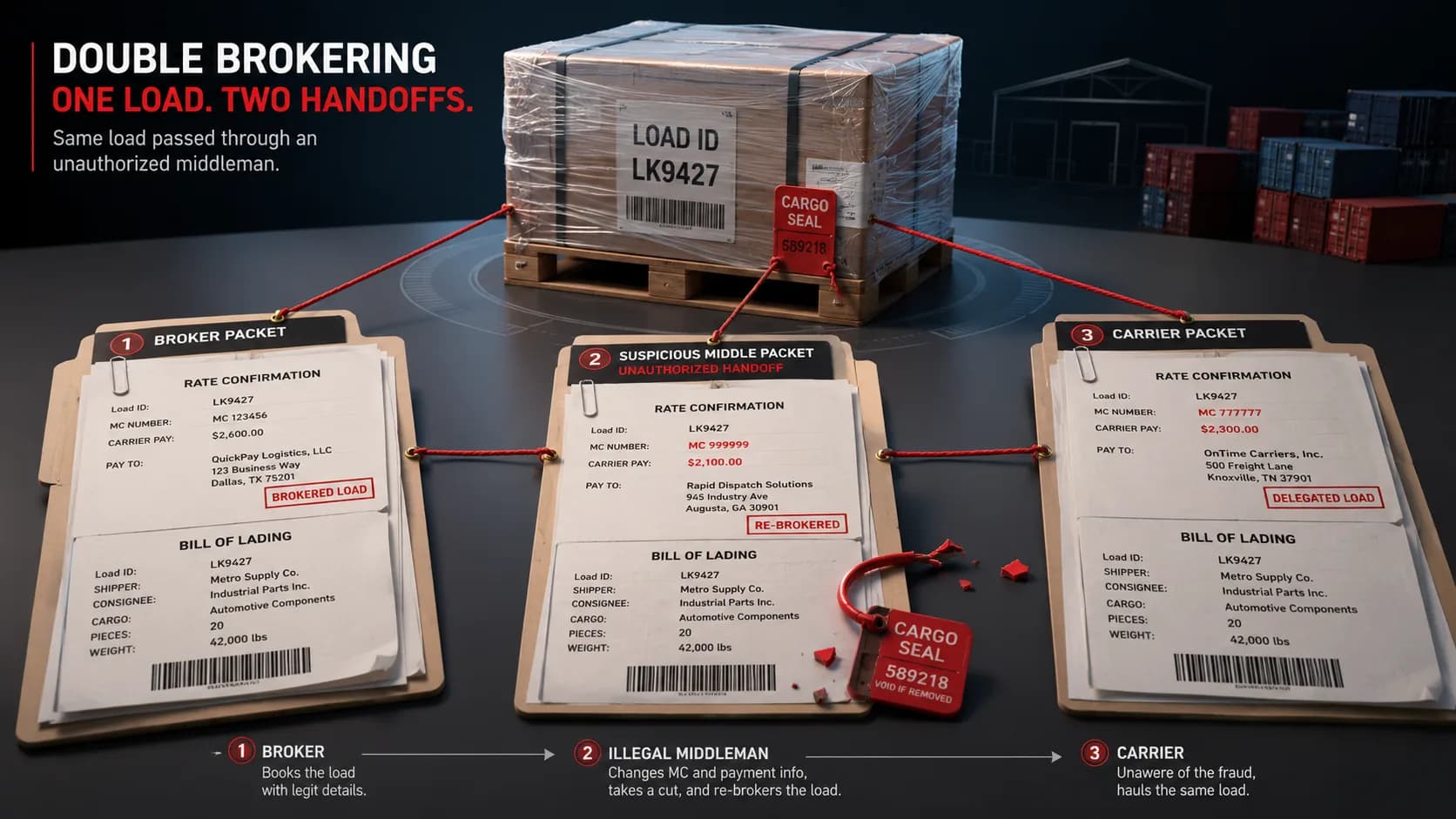
Double brokering gets described as a scam, and often it is one. But the thing that makes it possible is duller than a scam and much easier to check: whether the outfit holding your load is licensed to hand it to somebody else at all.
Most are not. That single fact is the most useful thing in this post, because it turns a vague worry into a yes or no question you can answer before the truck moves.
What re-brokering a load actually requires
Hauling freight and arranging for someone else to haul freight are two different licences. A motor carrier operates trucks. A broker arranges transportation it does not perform. Some companies hold both, which is entirely legitimate and common among larger operations that run their own equipment and place overflow elsewhere.
An outfit holding only carrier authority that takes your load and passes it to another carrier is not doing a version of brokering. It is arranging transportation without the licence to arrange transportation, and whatever contract you signed almost certainly forbade it too.
How rare dual authority actually is
This is measurable and, as far as we can find, unpublished. Matching active carrier authorities against active broker authorities on the same DOT number across the records we track:
- 381,711 carriers currently hold active operating authority.
- 25,976 brokers currently hold active broker authority.
- 3,654 DOT numbers hold both at once.
- That is about one active carrier in 104, or roughly 1%.
- Read the other way, about 14% of active brokers also run their own trucks.
So when a carrier hands your load to somebody else, the prior odds are heavily against that being something they are permitted to do. Ninety-nine times in a hundred there is no broker authority behind the handoff.
That is a better starting point than most double-brokering advice offers, because it replaces a judgement call with a lookup. You are not trying to read intent. You are checking a licence.
The shape it takes from the carrier's side
You find a load, accept it, haul it and deliver it. Then the invoice goes nowhere, because the company that gave you the load was never the company that owed the money. The broker who posted it paid somebody else, that somebody vanished, and you are left holding a receivable against an entity that has no obligation to you and frequently no assets.
The tell is almost always in the paperwork rather than in the behaviour. The name on the rate confirmation does not match the name on the bill of lading, or the shipper has never heard of the company you think hired you, or the pickup number was issued to a party nobody has mentioned.
The shape it takes from the broker's side
You tender to a carrier whose MC checks out. Somebody else collects the freight. You pay the entity you contracted with, and then the carrier that actually moved the load contacts you for payment you have already made once. Now you are deciding whether to pay twice or defend a claim, and the cargo was in the hands of a company you never vetted.
The onboarding equivalent of the licence check is worth building in, because a carrier that also holds broker authority is a different risk profile from one that does not. That is covered more fully in our broker's guide to carrier vetting.
What to check, in order
- Look up the MC or DOT yourself rather than trusting a packet you were emailed, and note whether the entity holds carrier authority, broker authority, or both.
- Match three names: the entity on the rate confirmation, the entity holding the authority, and the entity on the bill of lading. Disagreement among those three is the signal.
- Confirm with the shipper or receiver who they believe booked the load, on a call you place.
- Ask directly whether the load will be moved on the asking company's own equipment, and get the answer in writing.
- Treat a company with carrier-only authority offering you freight as a question, because arranging transportation is not something that licence covers.
- Keep the rate confirmation, bill of lading and delivery receipt together, since who contracted with whom is the entire dispute if this goes wrong.
What the licence check does not cover
Holding dual authority is not suspicious. It is a normal structure for an established operation, and the 3,654 companies that hold both are overwhelmingly legitimate businesses doing exactly what the licences permit. The figure is useful as a base rate, not as a flag.
The check also does not cover impersonation. If somebody is using another company's MC number, the authority they are quoting is genuine and the lookup will look fine, because you are checking a real company that is not the one you are talking to. That is a different failure with a different defence, covered in freight broker fraud and what the record can tell you.
And none of it measures intent. A licence check tells you what a company is permitted to do, not what it plans to do.
The bottom line
Double brokering survives on the assumption that a handoff is a grey area. Usually it is not. About 1% of active carriers can legally arrange transportation, which means the overwhelming majority of handoffs are straightforwardly outside what the licence allows, and you can establish that in the time it takes to run a lookup.
Check who holds what before you accept, keep the three names agreeing, and know how the party who actually owes you money tends to pay. A freight broker credit check answers the last one, and the free MC number lookup gives you identity, authority and bond with no account.
Frequently asked questions
Can a carrier legally re-broker a load to another carrier?
Only if that company also holds active broker authority, and most do not. Operating a truck and arranging for someone else to operate one are two separate licences. Matching active carrier authorities against active broker authorities on the same DOT number, we find 3,654 companies holding both, against 381,711 carriers with active operating authority. That is roughly one in 104. So when a carrier-only company passes your load to somebody else, it is almost always arranging transportation without the licence to do so, and the contract you signed very likely prohibited it as well.
How does a carrier end up hauling a double-brokered load?
The load is offered by a company presenting itself as the broker on the job when it is not. You accept, haul and deliver, then invoice a party that has no obligation to pay you, because the real broker already paid the intermediary who handed it on. The freight moved correctly, which is why nothing feels wrong until the invoice ages. The paperwork usually shows it earlier than the payment does: the name on the rate confirmation will not match the name on the bill of lading.
Will I get paid if the load I hauled was double brokered?
Often, but rarely easily and rarely in full. Your contract is with the party that gave you the load, and if that party has disappeared or has no assets, the claim is worth little. The routes that tend to work are a claim against the original broker's surety bond, and a direct approach to the original broker or the shipper, both of which depend on documents proving you moved the freight. Keep the rate confirmation, bill of lading and signed delivery receipt together, because possession and performance are what you will be establishing.
How can I tell a load has been re-brokered before I accept it?
Compare three names: the entity on the rate confirmation, the entity that holds the authority you looked up, and the entity named on the bill of lading. Disagreement among those is the clearest signal available before the truck moves. Then check whether the company offering the load holds broker authority at all, because a carrier-only authority is not licensed to arrange your transportation. Calling the shipper or receiver to ask who they believe booked the load settles most remaining doubt.
What should a broker do to stop a carrier double brokering a tendered load?
Make the licence check part of onboarding rather than a one-off, recording whether each carrier holds carrier authority, broker authority or both, since the risk profile differs. Require in the carrier agreement that the load moves on the carrier's own equipment and that any handoff needs written consent. Then verify at pickup, because the gap between the carrier you vetted and the truck that arrives is where the substitution happens. Confirming the driver and unit against what the carrier told you closes most of it.
What should I do if I suspect the load I am on was double brokered?
Deliver the freight unless you have a specific legal reason not to, because abandoning it usually weakens your position and can expose you to a cargo claim. Then document everything immediately: who contacted you, from which number and domain, the rate confirmation, the bill of lading and the signed delivery receipt. Contact the original broker named on the paperwork directly and tell them what happened, since they may not know either, and file against their surety bond early, in writing, because a bond is a shared pool and timing matters.